Bang-Bang Book

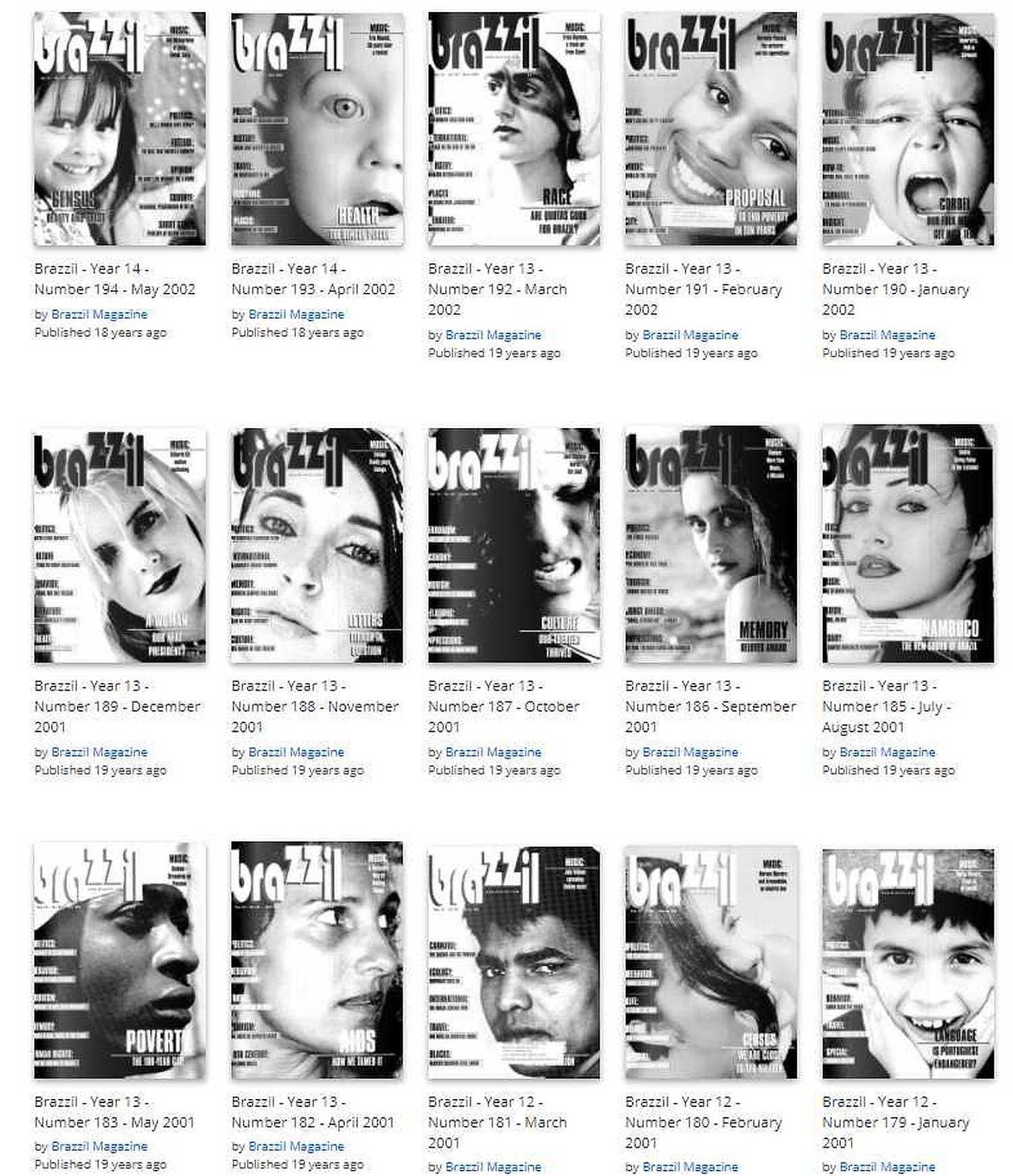
Brazzil Magazine covers

Bang-Bang
      Book

Patrícia Melo has a stripped-down, straightforward style, and she
pumps out words the way a gunman sprays bullets. With The Killer it’s as much like
watching a movie as reading a book.
By Bondo Wyszpolski

"Before we’re born, somebody, I don’t know who, God maybe, God defines exactly how
he’s going to fuck with our lives… God only thinks about people when he has to decide
how he’s going to destroy them. When he’s pressed for time, he comes up with a war or a
hurricane and kills them in droves, without having to give any thought at all. With me, he
gave it some thought."

Máiquel loses a soccer bet and dyes his hair blond. He’ll need a new wardrobe now, so
he goes shopping and hits up on the green salesgirl, Cledir. An acquaintance of his named
Suel comments on the new `gringo’ look and Máiquel takes offense. A minor incident gets
out of hand and Suel gets a bullet in the back, another in the head.

Nobody mourns the victim except his 15-year-old girlfriend, Érica. Meanwhile, Máiquel
is being lauded; you’d think he’d slain a dragon. When he goes to a dentist because of a
persistent toothache, Máiquel is told that he needs lots of dental work. Dr. Carvalho
says he’ll do it all for free if Máiquel knocks off the guy who raped his daughter.

Victim number two doesn’t seem like such a bad apple, but Máiquel accepts the offer,
botches but carries out the deed, and now he’s the biggest hot shot in town.

Having nowhere to go, Suel’s girlfriend Érica shows up and plants herself in
Máiquel’s house. In addition, Cledir reappears after being date-raped by Máiquel, and
she’s pregnant.

São Paulo author Patrícia Melo has a stripped-down, straightforward style, and she
pumps out words the way a gunman sprays bullets. The expression `cinematic’ is overused,
but with The Killer it’s as much like watching a movie as reading a book.

There are more offers from Dr. Carvalho and his cronies: they’re fed up with being
robbed, with the rampant crime in society that nobody’s doing anything about. But Máiquel
says no, or at least tries to. What he wants is to marry Cledir, be a dad, get a normal
job, and buy a house that’ll also have a room for Érica.

In the meantime, Máiquel remains a hired hand, knocking off petty thieves (many of
them poor black teenagers), his strings pulled by scared middle-class businessmen.

Máiquel reminds this reader of the anti-heroes in the writings of Oswaldo França,
Júnior (The Long Haul; The Man in the Monkey Suit), J.G. Noll (Hotel Atlântico),
and even Rubem Fonseca (Vast Emotions and Imperfect Thoughts), whose characters
drift, ramble, and are so often buffeted by the vagaries of fate.

Although it’s hard to imagine the São Paulo Chamber of Commerce sending copies to
potential visitors, The Killer is a heady, exhilarating ride that doesn’t run out
of steam. Sure, its direct punch and frank brutality will not be everyone’s cup of tea,
but those who pick up the book will learn one thing pretty quick: Melo delivers.

 Excerpt:

In the distance, I saw the scene. The prisoner’s hands and feet were tied, his pants
around his ankles. I’m going to give you a plate of shit, Zé Galinha said, if you eat it,
you go free. It wasn’t the first time Zé Galinha had dreamed up such things. I walked
faster. Enoque was holding the plate with the sack of shit, it’s all here, he told Zé
Galinha.

I quickly untied Conan’s hands. What’s the deal, Máiquel, let me finish my work. He’s
going to eat shit with a spoon, Máiquel, and you’re going to let me do it.

Nobody’s eating shit, I said. Put your clothes on, I told Conan. Conan was trembling so
much he couldn’t even get his pants on. I helped him, fastened his belt. Zé Galinha
wouldn’t stop talking, goddamn right he’s going to eat shit, Zé Galinha said, he’s going
to, he’s going to do it, I didn’t set up this circus for nothing, I didn’t shit in that
plastic bag for fun, that son of a bitch is going to eat shit, yessir, he sure as hell is.
I grabbed the plate out of Zé Galinha’s hands and threw it as far as I could, what’s
wrong, Máiquel? Just look, you got shit on my shoes, he said, you got my pants dirty with
shit, man. What’s the matter, you feel bad for Conan? Is that what it is? I’ve had it up
to here with you man, what’re you thinking, who you think you are, man? You’re a piece of
shit, that’s what you are. A piece of shit, he said. I took out the gun and fired, hit him
in the head. Zé Galinha fell dead.

Marcão and Enoque avoided looking at me.

Conan was trembling, thank you, he said. Conan also avoided looking me in the eye. He
was looking at my shoes, as if God were there, my shoe with its little gold chain. I shot
Conan three times in the head.


Send
your
comments to
Brazzil

Buy it at
Amazon.com

The Killer
218 pp
You May Also Like

Bronze sculpture of Zumbi dos Palmares, in Salvador, Bahia state

Palmares, Brazil’s Slave Rebellion, Still Going On 400 Years Later

The Quilombo dos Palmares was a nation of fugitive slaves, Indians, and a few ...

It seems the future never arrives in Brazil What Lies Ahead in Brazil? Brazil Has No Exemplary Past or Present. But What Lies Ahead for the Country? Europeans, US, developed country, developing country. Bolsonaro, future B. Michael Rubin For years, experts have debated what separates a developing country from a developed one. The GDP (Gross Domestic Product) of a country is one simple way to measure its economic development. Another way to measure a country's progress is the extent of public education, e.g. how many citizens complete high school. A country's health may be measured by the effectiveness of its healthcare system, for example, life expectancy and infant mortality. With these measurement tools, it's easier to gauge the difference between a country like Brazil and one like the U.S. What's not easy to gauge is how these two countries developed so differently when they were both "discovered" at the same time. In 1492 and 1500 respectively, the U.S. and Brazil fell under the spell of white Europeans for the first time. While the British and Portuguese had the same modus operandi, namely, to exploit their discoveries for whatever they had to offer, not to mention extinguishing the native Americans already living there if they got in the way, the end result turned out significantly different in the U.S. than in Brazil. There are several theories on how/why the U.S. developed at a faster pace than Brazil. The theories originate via contrasting perspectives – from psychology to economics to geography. One of the most popular theories suggests the divergence between the two countries is linked to politics, i.e. the U.S. established a democratic government in 1776, while Brazil's democracy it could be said began only in earnest in the 1980s. This theory states that the Portuguese monarchy, as well as the 19th and 20th century oligarchies that followed it, had no motivation to invest in industrial development or education of the masses. Rather, Brazil was prized for its cheap and plentiful labor to mine the rich soil of its vast land. There is another theory based on collective psychology that says the first U.S. colonizers from England were workaholic Puritans, who avoided dancing and music in place of work and religious devotion. They labored six days a week then spent all of Sunday in church. Meanwhile, the white settlers in Brazil were unambitious criminals who had been freed from prison in Portugal in exchange for settling in Brazil. The Marxist interpretation of why Brazil lags behind the U.S. was best summarized by Eduardo Galeano, the Uruguayan writer, in 1970. Galeano said five hundred years ago the U.S. had the good fortune of bad fortune. What he meant was the natural riches of Brazil – gold, silver, and diamonds – made it ripe for exploitation by western Europe. Whereas in the U.S., lacking such riches, the thirteen colonies were economically insignificant to the British. Instead, U.S. industrialization had official encouragement from England, resulting in early diversification of its exports and rapid development of manufacturing. II Leaving this debate to the historians, let us turn our focus to the future. According to global projections by several economic strategists, what lies ahead for Brazil, the U.S., and the rest of the world is startling. Projections forecast that based on GDP growth, in 2050 the world's largest economy will be China, not the U.S. In third place will be India, and in fourth – Brazil. With the ascendency of three-fourths of the BRIC countries over the next decades, it will be important to reevaluate the terms developed and developing. In thirty years, it may no longer be necessary to accept the label characterized by Nelson Rodrigues's famous phrase "complexo de vira-lata," for Brazil's national inferiority complex. For Brazilians, this future scenario presents glistening hope. A country with stronger economic power would mean the government has greater wealth to expend on infrastructure, crime control, education, healthcare, etc. What many Brazilians are not cognizant of are the pitfalls of economic prosperity. While Brazilians today may be envious of their wealthier northern neighbors, there are some aspects of a developed country's profile that are not worth envying. For example, the U.S. today far exceeds Brazil in the number of suicides, prescription drug overdoses, and mass shootings. GDP growth and economic projections depend on multiple variables, chief among them the global economic situation and worldwide political stability. A war in the Middle East, for example, can affect oil production and have global ramifications. Political stability within a country is also essential to its economic health. Elected presidents play a crucial role in a country's progress, especially as presidents may differ radically in their worldview. The political paths of the U.S. and Brazil are parallel today. In both countries, we've seen a left-wing regime (Obama/PT) followed by a far-right populist one (Trump/Bolsonaro), surprising many outside observers, and in the U.S. contradicting every political pollster, all of whom predicted a Trump loss to Hillary Clinton in 2016. In Brazil, although Bolsonaro was elected by a clear majority, his triumph has created a powerful emotional polarization in the country similar to what is happening in the U.S. Families, friends, and colleagues have split in a love/hate relationship toward the current presidents in the U.S. and Brazil, leaving broken friendships and family ties. Both presidents face enormous challenges to keep their campaign promises. In Brazil, a sluggish economy just recovering from a recession shows no signs of robust GDP growth for at least the next two years. High unemployment continues to devastate the consumer confidence index in Brazil, and Bolsonaro is suffering under his campaign boasts that his Economy Minister, Paulo Guedes, has all the answers to fix Brazil's slump. Additionally, there is no end to the destruction caused by corruption in Brazil. Some experts believe corruption to be the main reason why Brazil has one of the world's largest wealth inequality gaps. Political corruption robs government coffers of desperately needed funds for education and infrastructure, in addition to creating an atmosphere that encourages everyday citizens to underreport income and engage in the shadow economy, thereby sidestepping tax collectors and regulators. "Why should I be honest about reporting my income when nobody else is? The politicians are only going to steal the tax money anyway," one Brazilian doctor told me. While Bolsonaro has promised a housecleaning of corrupt officials, this is a cry Brazilians have heard from every previous administration. In only the first half-year of his presidency, he has made several missteps, such as nominating one of his sons to be the new ambassador to the U.S., despite the congressman's lack of diplomatic credentials. A June poll found that 51 percent of Brazilians now lack confidence in Bolsonaro's leadership. Just this week, Brazil issued regulations that open a fast-track to deport foreigners who are dangerous or have violated the constitution. The rules published on July 26 by Justice Minister Sérgio Moro define a dangerous person as anyone associated with terrorism or organized crime, in addition to football fans with a violent history. Journalists noted that this new regulation had coincidental timing for an American journalist who has come under fire from Moro for publishing private communications of Moro's. Nevertheless, despite overselling his leadership skills, Bolsonaro has made some economic progress. With the help of congressional leader Rodrigo Maia, a bill is moving forward in congress for the restructuring of Brazil's generous pension system. Most Brazilians recognize the long-term value of such a change, which can save the government billions of dollars over the next decade. At merely the possibility of pension reform, outside investors have responded positively, and the São Paulo stock exchange has performed brilliantly, reaching an all-time high earlier this month. In efforts to boost the economy, Bolsonaro and Paulo Guedes have taken the short-term approach advocated by the Chicago school of economics championed by Milton Friedman, who claimed the key to boosting a slugging economy was to cut government spending. Unfortunately many economists, such as Nobel Prize winner Paul Krugman, disagree with this approach. They believe the most effective way to revive a slow economy is exactly the opposite, to spend more money not less. They say the government should be investing money in education and infrastructure projects, which can help put people back to work. Bolsonaro/Guedes have also talked about reducing business bureaucracy and revising the absurdly complex Brazilian tax system, which inhibits foreign and domestic business investment. It remains to be seen whether Bolsonaro has the political acumen to tackle this Godzilla-sized issue. Should Bolsonaro find a way to reform the tax system, the pension system, and curb the most egregious villains of political bribery and kickbacks – a tall order – his efforts could indeed show strong economic results in time for the next election in 2022. Meanwhile, some prominent leaders have already lost faith in Bolsonaro's efforts. The veteran of political/economic affairs, Joaquim Levy, has parted company with the president after being appointed head of the government's powerful development bank, BNDES. Levy and Bolsonaro butted heads over an appointment Levy made of a former employee of Lula's. When neither man refused to back down, Levy resigned his position at BNDES. Many observers believe Bolsonaro's biggest misstep has been his short-term approach to fixing the economy by loosening the laws protecting the Amazon rainforest. He and Guedes believe that by opening up more of the Amazon to logging, mining, and farming, we will see immediate economic stimulation. On July 28, the lead article of The New York Times detailed the vastly increased deforestation in the Amazon taking place under Bolsonaro's leadership. Environmental experts argue that the economic benefits of increased logging and mining in the Amazon are microscopic compared to the long-term damage to the environment. After pressure from European leaders at the recent G-20 meeting to do more to protect the world's largest rainforest, Bolsonaro echoed a patriotic response demanding that no one has the right to an opinion about the Amazon except Brazilians. In retaliation to worldwide criticism, Bolsonaro threatened to follow Trump's example and pull out of the Paris climate accord; however, Bolsonaro was persuaded by cooler heads to retract his threat. To prove who was in control of Brazil's Amazon region, he appointed a federal police officer with strong ties to agribusiness as head of FUNAI, the country's indigenous agency. In a further insult to the world's environmental leaders, not to mention common sense, Paulo Guedes held a news conference on July 25 in Manaus, the largest city in the rainforest, where he declared that since the Amazon forest is known for being the "lungs" of the world, Brazil should charge other countries for all the oxygen the forest produces. Bolsonaro/Guedes also have promised to finish paving BR-319, a controversial highway that cuts through the Amazon forest, linking Manaus to the state of Rondônia and the rest of the country. Inaugurated in 1976, BR-319 was abandoned by federal governments in the 1980s and again in the 1990s as far too costly and risky. Environmentalists believe the highway's completion will seal a death knoll on many indigenous populations by vastly facilitating the growth of the logging and mining industries. Several dozen heavily armed miners dressed in military fatigues invaded a Wajãpi village recently in the state of Amapá near the border of French Guiana and fatally stabbed one of the community's leaders. While Brazil's environmental protection policies are desperately lacking these days, not all the news here was bad. On the opening day of the 2019 Pan America Games in Lima, Peru, Brazilian Luisa Baptista, swam, biked, and ran her way to the gold medal in the women's triathlon. The silver medal went to Vittoria Lopes, another Brazilian. B. Michael Rubin is an American writer living in Brazil.

Brazil Has No Exemplary Past or Present. But What Lies Ahead for the Country?

For years, experts have debated what separates a developing country from a developed one. ...

Brazilian writer and psychoanalyst Rubem AlvesTender Returns by Rubem Alves

Brazilian Writer Rubem Alves on the Mystery of Love

From Tender Returns, a new translation of Brazilian writer Rubem Alves. Alves, a theologian, ...

Italian Multi-instrumentalist Fabio Puglisi’s Latest Work Is a Love Letter to Brazil

Fabio Puglisi’s latest project, The Park Avenue Experience, delivers Diário, an album steeped in ...

Brazilian First Lady Marcela Temer and her husband - Beto Barata/PR

Brazil President Celebrates Women’s Day Reminding a Lady’s Place Is in the Kitchen and the Supermarket

Brazilian President Michel Temer delivered a speech Wednesday at his presidential palace in Brazilian ...