
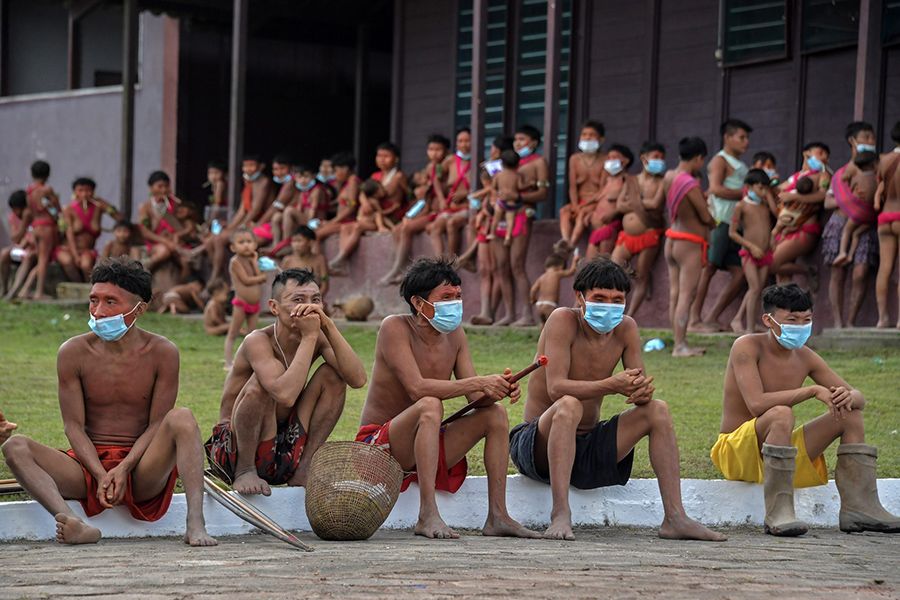
With Close to 1,000 Deaths, Brazil Indians Get an App to Keep Track of Covid-19

Indigenous and environmental organizations in Brazil launched an app aimed at alerting indigenous communities to the spread of the coronavirus pandemic in their lands.

“The application maps and periodically updates the situation regarding the pandemic in cities within a 100 kilometer radius of indigenous lands,” said the Coordination of the Indigenous Organizations of the Brazilian Amazon (COIAB) and the Amazon Environmental Research Institute (IPAM) in a joint statement.

The app, called “Covid-19 Indigenous Alert” aims to help indigenous people identify areas with high infection rates.

Provided free on the Android system, the app uses data from Brazil’s health ministry, people working in the indigenous health system, leaders from indigenous organizations and the COIAB network.

“This collection of information, as well as directing our strategies and actions to combat COVID-19, has exposed the lack of notification from public authorities and the serious way in which the new virus affects us,” said Mario Nicacio Wapichana, the deputy coordinator of COIAB.

With four million cases and over 125,000 deaths amongst its 212 million population, Brazil is the worst affected country in the world by the virus after the United States.

Amongst the 900,000 indigenous people there have been 30,000 infections and 785 deaths, according to The Articulation of Indigenous Peoples of Brazil (APIB.)

“Indigenous peoples are especially vulnerable to the new coronavirus, presenting an incidence rate 249% higher than the national average and a 224% higher mortality, according to analysis of the registered cases up to August 28,” said COIAB.

The network said low levels of immunity, the invasion of indigenous land by outsiders, the introduction of foreign pathogens and a weak health system “are some of the motives behind such alarming numbers.”

Several high-profile indigenous leaders have died of COVID-19.

However, earlier on Friday the 90-year-old iconic chief Raoni Metuktire, one of the most famous defenders of the Amazon rainforest, was released from hospital after a week receiving treatment for –19.

The leader of the Kayapo people, known for his colorful feather headdresses and the large disc inserted in his lower lip, has returned to his territory in Xingu National Park, in the center-west of Brazil.

The app, called “Covid-19 Indigenous Alert” aims to help indigenous people identify areas with high infection rates.

Four Million Cases

Brazil surpassed four million coronavirus cases, as an international panel looking into the global response to the pandemic vowed to uncover how it was able to spread worldwide.

“This is a strong panel poised to ask the hard questions,” said former Liberian president Ellen Johnson Sirleaf, co-chair of the Independent Panel for Pandemic Preparedness and Response (IPPR), which will rake over the heavily criticized World Health Organization-led response.

Meanwhile, Amnesty International said more than 7,000 health care workers have died of the virus worldwide, including more than 1,300 in Mexico alone, the most for any country.

The virus continued to disrupt the world of sport and entertainment, with filming of the new Batman movie halted in Britain because its star Robert Pattinson reportedly tested positive for the disease.

French football team Paris Saint-German said three more of its squad had been infected, a day after Neymar and two teammates were diagnosed, and Argentine football giants Boca Juniors said 18 of its players had tested positive just two weeks before restarting their Copa Libertadores campaign.

There were almost 44,000 new cases over a period of 24 hours alone, and 834 fatalities. However, some experts saw a silver lining in the statistics — Brazil could be on the verge of improvement.

“In the last two months, we have seen a curve that mixes regions that are increasing, with others that are decreasing,” said Paulo Lotufo, professor of epidemiology at the University of São Paulo, pointing to spikes in the south and center-west, while cases were falling in the major cities of São Paulo and Rio de Janeiro, as well as in the north.

But experts warned the situation could suddenly worsen again if local and regional governments give in to pressure from business groups to reopen the economy too soon, and if social distancing measures are abandoned.

Unlike in Europe and Asia, where the virus hit hard and then subsided, Brazil’s outbreak is advancing at a slow but devastating pace, said Christovam Barcellos, a researcher at public health institute Fiocruz.

“Brazil is unique in the world. Since the start of the pandemic, its curve has been different from other countries’, much slower”

“It has stabilized now, but at a very dangerous level: nearly 1,000 deaths and 40,000 cases per day…. And Brazil still isn’t past the peak.”

Brazil confirmed its first case of the virus on February 26, a São Paulo businessman returning from a trip to Italy. It recorded its first death on March 16. The pandemic soon turned political in Latin America’s largest country.

President Jair Bolsonaro condemned the “hysteria” around the virus, and attacked governors and mayors who imposed lockdown measures, arguing the economic damage would be worse than the disease itself.

The far-right leader has instead pushed the drug hydroxychloroquine as the solution to the health crisis, despite studies showing it is ineffective against Covid-19.

He again said recently the controversial medication had “saved thousands of victims’ lives” in Brazil. Bolsonaro even took what he called the “right-wing” drug himself when he was diagnosed with the virus in July.

Experts widely agree the lack of a cohesive message from Brazil’s leaders is responsible for the country’s failure to “flatten the curve.”

“It’s terrible. There’s been a total lack of coordination by the federal government, which unfortunately is another characteristic of the pandemic in Brazil,” said Barcellos.

The virus has meanwhile spread from the first demographic it infected – wealthy travelers returning from abroad – to more vulnerable groups and to the interior of the country.

Impoverished residents of overcrowded favelas, or slums, in cities such as Sao Paulo and Rio de Janeiro have been hit especially hard. So have indigenous groups in the Amazon rainforest, who have a history of vulnerability to outside diseases.

Island Has Protocol for Tourists

Fernando de Noronha, an archipelago 354km off Brazil’s northeastern coast famous for abundant sea life, pristine beaches and dramatic mountainsides rising above the coast, is trying a novel method for fighting the coronavirus.

Only tourists who have already had Covid-19 and recovered will be allowed onto the island chain, according to statements released by local and state governments.

The move by the tourism dependent archipelago, which has about 3,100 permanent residents, according to the most recent census estimate, speaks to the unique ways that state, local and national governments are trying to return to a semblance of normal as new Covid-19 cases and deaths stabilize in many parts of the world.

There is significant debate as to the level and duration of immunity that coronavirus patients develop after a first infection. There have been cases of re-infection reported, including in Brazil. However, such reports are relatively rare.

“There hasn’t been community transmission on the island for a long time. We have to keep it that way,” André Longo, the health secretary of the state of Pernambuco, said in a statement.

“Obviously, this step is going to be done with an eye on safety and reactivating economic activity on the archipelago.”

Fernando de Noronha has so far registered 93 confirmed cases of the virus and no deaths. It prohibited tourism starting in March. For a period from April to June, even residents who were on the mainland were not allowed to return.

Finances Deteriorating

Brazil’s finances continued to deteriorate in July as the COVID-19 crisis pushed the public sector debt and deficit as a share of the economy to new records, official figures showed, although not as bad as economists had feared.

The national debt rose to a record 86.5% of gross domestic product in July and the public sector primary deficit in the month, excluding interest payments, was 81.1 billion reais (US$ 15 billion), the central bank said.

The primary deficit in the 12 months to July rose to 537 billion reais from 459 billion reais in June, the central bank said. As a share of GDP, it widened to 7.5% from 6.4% in June, and just 0.8% pre-coronavirus in February.

In the first seven months of the year, the primary deficit ran at 11.9% of GDP, compared with just 0.2% of GDP in the same period last year.

The latest official government forecast is for a public sector primary deficit of 812 billion reais this year, or 11.3% of GDP. But that does not include the extension of emergency aid payments to the poor announced by President Jair Bolsonaro and expected to be confirmed this week.

Alberto Ramos, head of Latin American research at Goldman Sachs, expects the picture to deteriorate as the recession hammers tax revenues and prompts additional government spending.

“We now expect the consolidated public sector to record a primary fiscal deficit of around 13% of GDP (likely higher) … and gross public debt to close over 95% of GDP,” he wrote on Monday.

In nominal terms, including interest payments, the public sector deficit was 86.9 billion reais in July, the central bank said, also less than the expected 109.9 billion reais.

Mercopress

Tags:

You May Also Like

Residents of Nova Palestina favela in São Paulo - Marcelo Camargo/ABr

When Housing Rights for Brazil’s Poor Clash with Drinkable Water for 5 Million

  On the fringes of São Paulo, hundreds of makeshift dwellings fashioned from discarded ...

Brazzil Magazine covers

Hydra of Lerna: Brazil’s New Anti-Corruption Action Goes After Ministers and Governor

Brazil’s Federal Police officers executed warrants for Operation Hydra of Lerna at the Workers’ ...

Amazon, the land of fantasy

Turning It into a Magic Place Is Not Doing the Amazon Any Good

The Amazon, perhaps more than any other region of the globe, has consistently been ...

It seems the future never arrives in Brazil What Lies Ahead in Brazil? Brazil Has No Exemplary Past or Present. But What Lies Ahead for the Country? Europeans, US, developed country, developing country. Bolsonaro, future B. Michael Rubin For years, experts have debated what separates a developing country from a developed one. The GDP (Gross Domestic Product) of a country is one simple way to measure its economic development. Another way to measure a country's progress is the extent of public education, e.g. how many citizens complete high school. A country's health may be measured by the effectiveness of its healthcare system, for example, life expectancy and infant mortality. With these measurement tools, it's easier to gauge the difference between a country like Brazil and one like the U.S. What's not easy to gauge is how these two countries developed so differently when they were both "discovered" at the same time. In 1492 and 1500 respectively, the U.S. and Brazil fell under the spell of white Europeans for the first time. While the British and Portuguese had the same modus operandi, namely, to exploit their discoveries for whatever they had to offer, not to mention extinguishing the native Americans already living there if they got in the way, the end result turned out significantly different in the U.S. than in Brazil. There are several theories on how/why the U.S. developed at a faster pace than Brazil. The theories originate via contrasting perspectives – from psychology to economics to geography. One of the most popular theories suggests the divergence between the two countries is linked to politics, i.e. the U.S. established a democratic government in 1776, while Brazil's democracy it could be said began only in earnest in the 1980s. This theory states that the Portuguese monarchy, as well as the 19th and 20th century oligarchies that followed it, had no motivation to invest in industrial development or education of the masses. Rather, Brazil was prized for its cheap and plentiful labor to mine the rich soil of its vast land. There is another theory based on collective psychology that says the first U.S. colonizers from England were workaholic Puritans, who avoided dancing and music in place of work and religious devotion. They labored six days a week then spent all of Sunday in church. Meanwhile, the white settlers in Brazil were unambitious criminals who had been freed from prison in Portugal in exchange for settling in Brazil. The Marxist interpretation of why Brazil lags behind the U.S. was best summarized by Eduardo Galeano, the Uruguayan writer, in 1970. Galeano said five hundred years ago the U.S. had the good fortune of bad fortune. What he meant was the natural riches of Brazil – gold, silver, and diamonds – made it ripe for exploitation by western Europe. Whereas in the U.S., lacking such riches, the thirteen colonies were economically insignificant to the British. Instead, U.S. industrialization had official encouragement from England, resulting in early diversification of its exports and rapid development of manufacturing. II Leaving this debate to the historians, let us turn our focus to the future. According to global projections by several economic strategists, what lies ahead for Brazil, the U.S., and the rest of the world is startling. Projections forecast that based on GDP growth, in 2050 the world's largest economy will be China, not the U.S. In third place will be India, and in fourth – Brazil. With the ascendency of three-fourths of the BRIC countries over the next decades, it will be important to reevaluate the terms developed and developing. In thirty years, it may no longer be necessary to accept the label characterized by Nelson Rodrigues's famous phrase "complexo de vira-lata," for Brazil's national inferiority complex. For Brazilians, this future scenario presents glistening hope. A country with stronger economic power would mean the government has greater wealth to expend on infrastructure, crime control, education, healthcare, etc. What many Brazilians are not cognizant of are the pitfalls of economic prosperity. While Brazilians today may be envious of their wealthier northern neighbors, there are some aspects of a developed country's profile that are not worth envying. For example, the U.S. today far exceeds Brazil in the number of suicides, prescription drug overdoses, and mass shootings. GDP growth and economic projections depend on multiple variables, chief among them the global economic situation and worldwide political stability. A war in the Middle East, for example, can affect oil production and have global ramifications. Political stability within a country is also essential to its economic health. Elected presidents play a crucial role in a country's progress, especially as presidents may differ radically in their worldview. The political paths of the U.S. and Brazil are parallel today. In both countries, we've seen a left-wing regime (Obama/PT) followed by a far-right populist one (Trump/Bolsonaro), surprising many outside observers, and in the U.S. contradicting every political pollster, all of whom predicted a Trump loss to Hillary Clinton in 2016. In Brazil, although Bolsonaro was elected by a clear majority, his triumph has created a powerful emotional polarization in the country similar to what is happening in the U.S. Families, friends, and colleagues have split in a love/hate relationship toward the current presidents in the U.S. and Brazil, leaving broken friendships and family ties. Both presidents face enormous challenges to keep their campaign promises. In Brazil, a sluggish economy just recovering from a recession shows no signs of robust GDP growth for at least the next two years. High unemployment continues to devastate the consumer confidence index in Brazil, and Bolsonaro is suffering under his campaign boasts that his Economy Minister, Paulo Guedes, has all the answers to fix Brazil's slump. Additionally, there is no end to the destruction caused by corruption in Brazil. Some experts believe corruption to be the main reason why Brazil has one of the world's largest wealth inequality gaps. Political corruption robs government coffers of desperately needed funds for education and infrastructure, in addition to creating an atmosphere that encourages everyday citizens to underreport income and engage in the shadow economy, thereby sidestepping tax collectors and regulators. "Why should I be honest about reporting my income when nobody else is? The politicians are only going to steal the tax money anyway," one Brazilian doctor told me. While Bolsonaro has promised a housecleaning of corrupt officials, this is a cry Brazilians have heard from every previous administration. In only the first half-year of his presidency, he has made several missteps, such as nominating one of his sons to be the new ambassador to the U.S., despite the congressman's lack of diplomatic credentials. A June poll found that 51 percent of Brazilians now lack confidence in Bolsonaro's leadership. Just this week, Brazil issued regulations that open a fast-track to deport foreigners who are dangerous or have violated the constitution. The rules published on July 26 by Justice Minister Sérgio Moro define a dangerous person as anyone associated with terrorism or organized crime, in addition to football fans with a violent history. Journalists noted that this new regulation had coincidental timing for an American journalist who has come under fire from Moro for publishing private communications of Moro's. Nevertheless, despite overselling his leadership skills, Bolsonaro has made some economic progress. With the help of congressional leader Rodrigo Maia, a bill is moving forward in congress for the restructuring of Brazil's generous pension system. Most Brazilians recognize the long-term value of such a change, which can save the government billions of dollars over the next decade. At merely the possibility of pension reform, outside investors have responded positively, and the São Paulo stock exchange has performed brilliantly, reaching an all-time high earlier this month. In efforts to boost the economy, Bolsonaro and Paulo Guedes have taken the short-term approach advocated by the Chicago school of economics championed by Milton Friedman, who claimed the key to boosting a slugging economy was to cut government spending. Unfortunately many economists, such as Nobel Prize winner Paul Krugman, disagree with this approach. They believe the most effective way to revive a slow economy is exactly the opposite, to spend more money not less. They say the government should be investing money in education and infrastructure projects, which can help put people back to work. Bolsonaro/Guedes have also talked about reducing business bureaucracy and revising the absurdly complex Brazilian tax system, which inhibits foreign and domestic business investment. It remains to be seen whether Bolsonaro has the political acumen to tackle this Godzilla-sized issue. Should Bolsonaro find a way to reform the tax system, the pension system, and curb the most egregious villains of political bribery and kickbacks – a tall order – his efforts could indeed show strong economic results in time for the next election in 2022. Meanwhile, some prominent leaders have already lost faith in Bolsonaro's efforts. The veteran of political/economic affairs, Joaquim Levy, has parted company with the president after being appointed head of the government's powerful development bank, BNDES. Levy and Bolsonaro butted heads over an appointment Levy made of a former employee of Lula's. When neither man refused to back down, Levy resigned his position at BNDES. Many observers believe Bolsonaro's biggest misstep has been his short-term approach to fixing the economy by loosening the laws protecting the Amazon rainforest. He and Guedes believe that by opening up more of the Amazon to logging, mining, and farming, we will see immediate economic stimulation. On July 28, the lead article of The New York Times detailed the vastly increased deforestation in the Amazon taking place under Bolsonaro's leadership. Environmental experts argue that the economic benefits of increased logging and mining in the Amazon are microscopic compared to the long-term damage to the environment. After pressure from European leaders at the recent G-20 meeting to do more to protect the world's largest rainforest, Bolsonaro echoed a patriotic response demanding that no one has the right to an opinion about the Amazon except Brazilians. In retaliation to worldwide criticism, Bolsonaro threatened to follow Trump's example and pull out of the Paris climate accord; however, Bolsonaro was persuaded by cooler heads to retract his threat. To prove who was in control of Brazil's Amazon region, he appointed a federal police officer with strong ties to agribusiness as head of FUNAI, the country's indigenous agency. In a further insult to the world's environmental leaders, not to mention common sense, Paulo Guedes held a news conference on July 25 in Manaus, the largest city in the rainforest, where he declared that since the Amazon forest is known for being the "lungs" of the world, Brazil should charge other countries for all the oxygen the forest produces. Bolsonaro/Guedes also have promised to finish paving BR-319, a controversial highway that cuts through the Amazon forest, linking Manaus to the state of Rondônia and the rest of the country. Inaugurated in 1976, BR-319 was abandoned by federal governments in the 1980s and again in the 1990s as far too costly and risky. Environmentalists believe the highway's completion will seal a death knoll on many indigenous populations by vastly facilitating the growth of the logging and mining industries. Several dozen heavily armed miners dressed in military fatigues invaded a Wajãpi village recently in the state of Amapá near the border of French Guiana and fatally stabbed one of the community's leaders. While Brazil's environmental protection policies are desperately lacking these days, not all the news here was bad. On the opening day of the 2019 Pan America Games in Lima, Peru, Brazilian Luisa Baptista, swam, biked, and ran her way to the gold medal in the women's triathlon. The silver medal went to Vittoria Lopes, another Brazilian. B. Michael Rubin is an American writer living in Brazil.

Brazil Has No Exemplary Past or Present. But What Lies Ahead for the Country?

For years, experts have debated what separates a developing country from a developed one. ...

Guarulhos International Airport in São Paulo, Brazil

Citing Reciprocity, Brazil Ends Visa Exemption for USA, Canada and Australia

The visa requirement for tourists from Australia, Canada, and the United States, planning to ...