
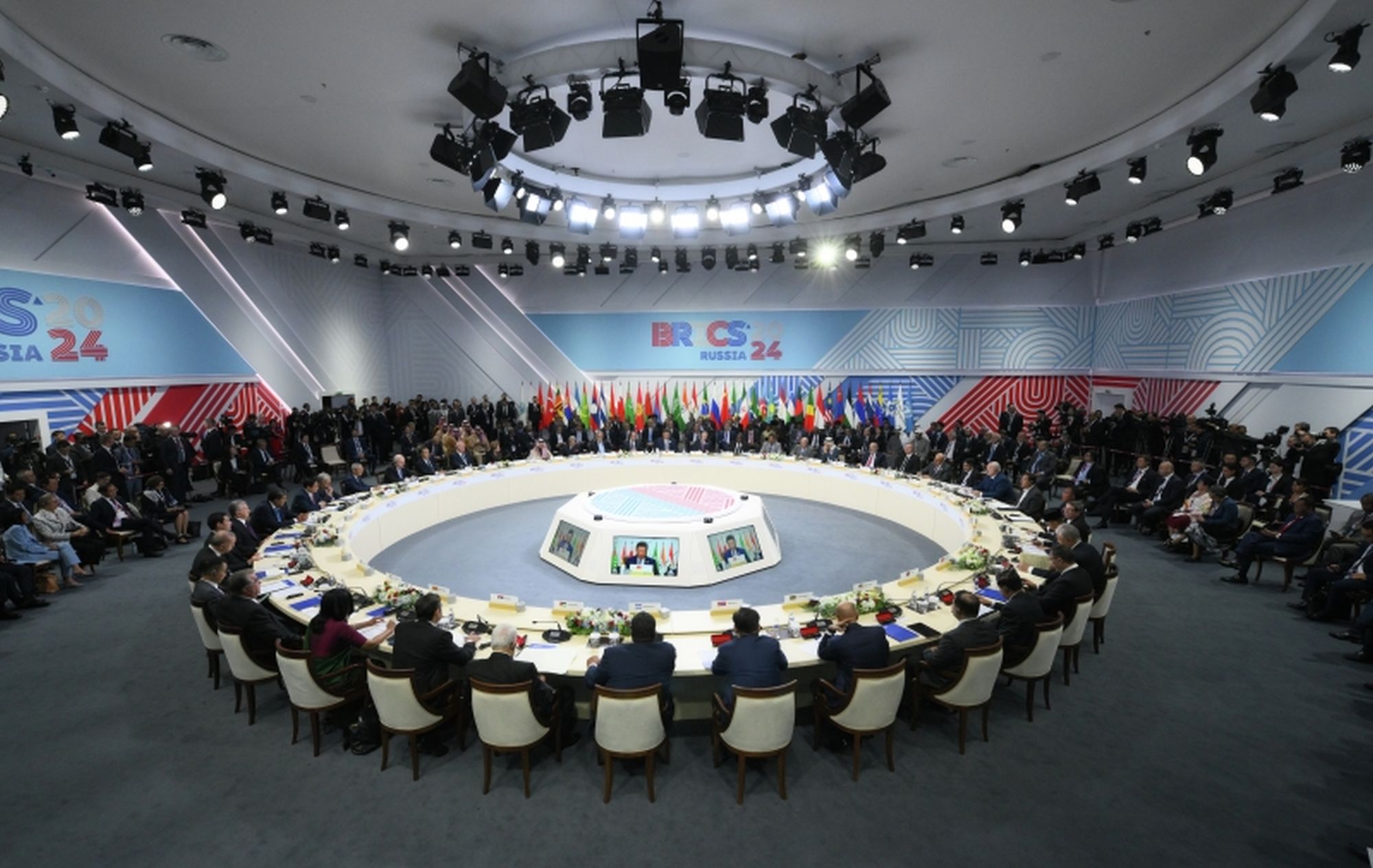
The sixteen BRICS summit was hosted by Russia last October 22-24 in Kazan, the Christian Orthodox and Muslim capital of Tatarstan province. By most accounts, it was an astounding success with President Vladimir Putin snubbing the part the G7 infotainment nightmare has typecast for him. He soared above mediocre imagery by portraying an overly intelligent global leader. He shined as a graceful and welcoming host, overflowing with brilliant ideas and leading his Eurasian federation on a crest of recovery and rediscovery. Yet, if for your news you rely on the Russia-baiting, fearing and smearing G7 intel-infiltrated media, you probably would not have heard anything about this world historical week.
In the eyes of Western Europe, where censorship is rampant of any pro-Palestinian and Lebanese utterances on the right to live, the BRICS was merely a platform for “Putin” to keep threatening the western global order. That homegrown masses fall so easily for bad weed results from the downplaying, excision, and shadow-banning of any type of cultural and political material showing the virtues of Russia and China. As of 2014 and Maidan, Russia had turned toward China for inspiration and support. Today, China celebrates at least one global power that joins its vision of a planet able to thrive through trade instead of wallowing in wars.
With the BRICS Kazan summit in mind, what is more doubtful is how President Lula da Silva fares after the ambivalence shown by his delegation toward the multipolar world. Lula himself has suffered an accident on the eve of his departure, leaving the summit without his charm, albeit freeing its objectives from his domestic constraints. As the meeting was ending, Lula’s Secretary of State, Mauro Vieira, issued a veto over Venezuela’s joining the coalition. Brazil tried to justify it with a friendly neighbor clause conveniently slid into the conditions allowing new nations to join. After fussing about the way Caracas runs its internal affairs, this new move against its friendliest of neighbors has put Lula in a bind. The fallout has been devastating for his reputation at home and in the global south alike. As for its northern neighbor, it symbolizes nothing less than a stab in the back.
BACKGROUND
By the end of Lula’s second term as president in 2010, Brazil seemed to be the leader the BRICS project had needed. Through the outstanding work of the then Foreign Minister and now Special Advisor to the Presidency, Ambassador Celso Amorim, the rise of the coalition seemed to usher in a truly post-colonial age. As a trade organization, its share of international production largely paled in comparison to today. It was hardly sufficient to evoke even the 1955 Bandung Conference of non-aligned nations. In 2001, while largely still a speculation and capturing only as much as 12 percent of global GDP, a Goldman Sachs analyst had found it right to coin its name. The suggestion was that the blueprint represented a future alternative to G7 global hegemony.
If Goldman Sachs had branded the name, it did not invent the idea. While neo-cons and Western media yelped and howled at the downfall of the Soviet model, Russian diplomat and political leader Yevgeny M. Primakov was thinking about the future. He tested the grounds for the formation of a coalition bringing together the largest economies outside the G7. Back then, Brazil was not part of the simulation. What grew into the Primakov Doctrine sought to fuse his country, China and India. It appeared as a potential game changer and revealed a path of economic recovery for Russia after its economy had succumbed to the Wall Street/CIA-prescribed neoliberal shock doctrine. The model was born during the period when the production centers of the industrial economies began leaving the G7 zone. Greeting them in post-Maoist China was a renewed industrial working-class framework.
In 2006, Brazil’s admission to the discussion about a trade alliance occurred just in time for Lula’s second mandate. The country had entered its most affluent decade by assuming a position of leadership for the global south as domestic production inched toward a four-percent rate in nominal GDP growth. After the first summit was held in 2009, the BRIC then gained an S as South Africa achieved membership a year later. According to the most recent indicators, the BRICS+ will again surpass the G7 in GDP growth this year. In its expanded format, it accounts for 35.4 percent of world production, instead of the stagnant Euroamerican colonialist club shrinking to 29.6 percent.
Matching China’s decades-long unprecedented rise from poverty, Russia has skyrocketed to international prestige despite facing the largest set of illegal sanctions ever imposed against a country. It now captures the fourth-highest spot in GDP as measured by purchasing power parity, a result certified by the IMF. Russia is looking at 4 percent nominal growth this year. Brazil itself is not doing badly in terms of its expected GDP growth. However, the nominal rate has yet to be converted into a rise in PPP. For Brazil’s income spread keeps eroding at the bottom of a pit of unjustified inequality.
Amidst Russia’s military victory against NATO in what is left of Ukraine, this year’s summit had two focuses. After formalizing its expansion to nine member states, the summit tabled plans to further articulate a BRICS+ internal trade currency, with the ramifications defined for clearing, reinsurance and exchange. The governing structure of the organization was also reinforced and celebrated. As the Kazan Declaration proclaims, the catch phrase for BRICS is “Strengthening Multilateralism for Just Global Development and Security”. In the plenary “Outreach” plenary session, President Putin transformed design into reality by granting over thirty state leaders, including President of the State of Palestine Mahmoud Abbas and the Secretary General of the United Nations, the space to share considerations on the challenges facing the new planetary configuration.
Membership is a key issue for BRICS. Its policy decisions are based on consensus, with each member state having an equal say. Such a criterion makes inclusion of newcomers a delicate affair, leading the core members to create an intermediary group of fourteen associated partners. Recently, speculations as to the strength of India’s commitment to the coalition have come into the media spotlight. That was definitively settled before the beginning of the summit, when China and India signed an entente regarding their border issues over the Himalayan region. Meanwhile, Brazil was seen by its Russian and Chinese counterparts as the stepping stone toward future multipolarity. Ex-president Dilma Rousseff has headed the New Development or BRICS Bank, since Lula’s return to the presidency in 2023. She has been commended for her work by Chinese President Xi Jinping and has been invited by President Putin to continue at the helm of the bank.
Still, in recent weeks, the position of Brazil’s government has started to oscillate. First, the government hesitated on Iran’s joining. Then Lula used the country’s veto power to bar Venezuela’s bid, this merely a day after its delegation had promised not to veto it. The deception in intellectual circles has been severe not only for Brazil, but for Lula as well. Following the military high command, the Congress and the Supreme Court, the latest state institution to throw a net over Lula’s government has been the national state department, also known as “Itamaraty”.
These developments have prompted a much-needed reality check among international observers regarding the current structure of the country’s state and government. If Brazil’s democracy is riddled with contradictions, authoritarianism hardly names what is at stake. In fact, it never does and should be ditched from the political lexicon. Agitating just below Lula is a white-settler-colonialist semi-apartheid state, similar to the U.S. or Israel. Its immoral nature is confirmed scandalously by the ongoing genocide of the Yanomamö “forest” people, when not of the Afro-descendant teenage male population.
Should one focus criticism on Lula alone, or associate him with the interests of the US, one would be misreading the dominant political establishment. After his criticism of the Israeli government’s genocide of the Palestinian people, the carpet has been pulled from under his feet. As the host of the upcoming G20 summit, Lula has been compelled to remain in line with its core G7 values. To further the point, Celso Amorim has declared publicly that there will be no inclusion of Brazilian industry into the One Belt, One Road Initiative.
There is little doubt that Lula’s government has reached the end of its left-of-center spindle. As the string runs out, the situation has become dramatic.
FROM THE INSIDE
While there is little to justify not including Venezuela into the BRICS+ based on the issue of trade, and trade alone, the fact that Lula was compelled to bar it only points to the diminishing margin of maneuver on domestic issues he appears to possess. Yet those criticizing Lula for being under Washington, D.C.’s control base their suppositions on the assumption that Brazil’s sovereignty as a nation extends to military and financial matters. Well, it does not.
As for what the country’s dominant sectors do represent, Washington finds itself with a near perfect proxy for military, legal, and financial affairs. Moreover, most power brokers in Brasília maintain tight links not only with American Intel agencies but with Mossad as well. In fact, it would not be off the cuff to suggest that Brazil is as much a part of the strategic alliance of the United States as Israel, if it is not an outright Israeli commercial colony. By consulting the history of economic indicators, it is easy to see how the country’s dominant sectors simply do not work toward the collective well-being of the population. Bolsonaro has only ever been the impersonating voice of the military high command, whose game plan is to force through measures of hyper-privatization to jettison any future possibility of broad public spending. The specter of fascism awaits any government that tries.
Furthering the point, only days after the BRICS+ debacle, Congress rejected a bill aimed at taxing individuals worth more than 10 million reais. While taxing the super rich may not be the main solution for overcoming obstacles to social investments, how fiercely the upper-class rejects it is instructive in itself as to the dynamics behind the reproduction of wealth. Economist Maria Lucia Fattorelli has tirelessly argued for an audit of the country’s public debt servicing apparatus. The fiscal constraints on the government affect only social spending. Whereas public debt servicing saw a spike from 1.4 billion reais to 2.4 in 2020 alone, education and culture stagnated at a miserly 200 million. A recently published FGV study by another economist, Sérgio Gobetti, shows that the taxes paid by individuals earning 1 million reais per month or more are equal to those paid by someone earning only 6,000 reais, the rate being 12.9 percent. Meanwhile, the media sickeningly hums the refrain in unison as to how the country is supposedly the most taxed among developed nations. Since 2017, the top 1% went from holding 20.4% to 23.7% of total national wealth, an unprecedented draining of public wealth into private hands.
The upshot is that there is no limit, either from below, or much less from above, to the funds available to a state, provided it seeks to acquire them. It is as much a question of taxation as it is of efficient collection. When taxable revenue legally leaves a country to accumulate in offshore accounts, taxing the super rich domestically is by no means enough. For such fiscal control to exist, the top members of the state and surveillance hierarchy cannot be those benefiting from the gaps.
With no increases to investment in sustainable and innovative industry, education, or health, the far-right-controlled Congress has reiterated its stance on relegating the country’s economy to remain a privatized supplier of commodities. It has silenced any whisper of technological innovation, while those who try end up being branded as communists. A north-Atlantic cooptation of national brains and innovators does the rest. Current estimates point to 7 million Brazilians living legally in G7 countries. It represents nothing short of a brain and labor drain.
By evoking as much, it was President Putin himself who correctly framed the matter by disagreeing with Lula and questioning the degree of sovereignty the country actually possesses. Lula’s hold on power is the opposite to Putin’s. Brazil’s 1988 Constitution, drafted on the heals of a twenty-year long military dictatorship, deliberately prepared Congress against any power-concentrating attempts at the executive level. On paper, it was understandable, given that for over two decades, the country was ruled by a sequence of generals who had not been elected to power. Between the lines, though, the unusual mixture of a presidential and a parliamentary system is aimed at keeping any progressive president from carrying out a political agenda strong enough to oust the ruling oligarchy. Neither Lula nor Dilma Rousseff’s presidencies benefitted from a Workers’ Party (PT) majority in Congress. The need for alliances in the legislature and senate required them to sleep with the least hostile of enemies, a case never truer than now.
Meanwhile, the current Brazilian oligarchy acts as an upholder of the Monroe Doctrine from within. Well before the so-called Cold War, the Monroe Doctrine aimed at keeping liberated African-Americans from rising to positions of power. It stands true even more for Brazil, where blacks make up over half the population. The plight they face in much of the country as they seek better living conditions exposes social reality as an off-the-record apartheid state. For Brazil to mature, it must first be honest with itself. As the oligarchy takes heed of BRICS+, that opportunity seems to be fading away, as it did following the 2013 color revolution that was black. Like the U.S., Canada and Israel, the white settler-colonialist regime prevails in Brazil.
Inasmuch as it does, one of Bolsonaro’s most effective moves while in power was to increasingly pass on policy decisions to Congress. He was arguably carrying out the function the military chiefs of staff had secretly decided. To revert Lula and Dilma Rousseff’s emboldening of civil society by means of investing socially, the four-star generals focused on building Congress into a barrier against the Executive and the Workers’ Party. In short, their relinquishing of the power of the presidency since 1988 has been matched with a determination to seize it at the congressional level. For serving seven terms as a representative of the lower house, this is a place Bolsonaro could call home.
Lula and the few cabinet ministers loyal to his vision find themselves in a straight jacket. The constitutional tables have been reversed. We might be witnessing one of the weakest presidencies, still achieving success either internationally or domestically.
FROM THE RIVER TO THE FOREST
So the post-summit debate has been fierce. It can be channeled into two main currents. The first idealizes Lula’s struggle within the framework of imperialism, whose rules are set abroad, which raises doubts about his integrity when he comes up against obstacles. The second recognizes how the strongest obstacles emerge due to the subsistence of a customized white-settler colonialist order. The result is the same. What changes is whether the attempt to suppress popular struggle comes from abroad or from within.
The United Nations charter on the sovereignty of nations used to be the ultimate mediator regarding international relations. Russia’s Special Military Operation, launched against the Kiev Regime, popped that idealized bubble. In its stead, we would be remiss not to think first in terms of geopolitical influence and only after according to the rights of nations. Whether this seems like a capitulation to Russia’s alleged advance into European territories should be put to rest as soon as one admits that the United States has since the end of the Civil War expelled one by one all the European powers from the continent. According to this logic, which no American will doubt even as they fret about Russia, it is normal for the State Department to prevent further entry on the continent to China.
This is ultimately the reason why Lula had to veto Venezuela, although he is not forced to like Argentina’s Milei or Chile’s Boric. What Lula did not do was pretend to invite Argentina to join BRICS knowing it would not. Under no illusion about Milei’s rejecting the invitation, what Lula bet on was whether an attempt to solve Argentina’s spiraling public debt by a Chinese buy out of the IMF-owed state debt would not dramatically change voter intent. Most Argentines understand that under Milei their country would become a colony of the United States. Lula simply tried to prevent that from happening.
Ironically, Cuba is easier for Brazil to defend. Then again, communism has never been the real enemy, at least not if it allowed access to resources. Consider China as exhibit A. It allowed the United States to access its enormous pool of labor power. As for Venezuela, it possesses the largest oil reserves in the world. And if South America does not want to become a new theater for a proxy war, it had better make that oil available for Uncle Sam.
Doubtless, this rendition is a version of realism regarding geopolitical relations. However, it does not entirely explain the dynamics involved in the crunch pressuring Lula. That arises internally, as the country’s most astute observers have defended. According to the Gini Index, Brazil continues year after year, decade after decade, to stand as one of the world’s most unequal nations. Concentration of wealth is comparable to European colonial regimes in Algeria, for example, or Gaza today. As in South Africa or Rhodesia in its day, so as to function colonialism requires the existence of apartheid, namely the expulsion of the vast majority from any entitlement to private property, companies, or capital. Concentrating wealth in turn allows for concentration of telecommunications, which is the case in Brazil. The media found here shamelessly anti-nationalism, as it bends to the rules-based world order. In the government, one can perhaps count on two hands alone the number of ministers who refuse to salute their masters in D.C., New York, or Disneyland.
Lula sometimes jokes about how, after his first election as president in 2002, Congress gifted him with a fast-track law slashing his salary to that of an elementary school teacher’s. However, his government had money. And it for twelve years, it was able to invest heavily in the social sphere. By the turn of the decade, European academics were flocking to the Tropical Union as a new land of opportunity appeared on the horizon.
After ousting Dilma Rousseff in a coup following her re-election in 2015, the first measure the illegitimate Temer government passed was to cap any increase to the budget above adjustments for inflation for twenty-five years. As the Central Bank responded to the oligarchy, it bled public coffers to the hilt with artificially boosted financial servicing resulting from the world’s highest interest rates on debt. For two-thirds of the population, it meant they were at the mercy of a deregulated market controlled primarily by whites. Native whites, who do not like Blacks or Indigenous individuals. Nothing has changed, and the Whites will stop at nothing to prevent the latter from getting a share of the pie.
According to its framer, BRICS+ seeks a decentered multipolarity. It has no and needs no military ambitions. The Shanghai Cooperation Organization exists to deal with those matters. There is irony in the BRICS+ debacle. In the end, Brazil fails to fit in not so much due to upholding the democratic, liberal, and human rights values of Western civilization. It would not because, as opposed to Russia, China, South Africa and now Iran, it has never had a revolution to rid it from the decadent nobility controlling the nation ever since the days of the Império and the times of slavery. Beyond the backyard and toward the BRICS+, the deep revolution awaiting the country will prove its brightest future can only arise through a Palmares with Chinese characteristics.
Norman Madarasz, Ph.D., is professor of economic philosophy and ontology, and a geopolitical analyst.