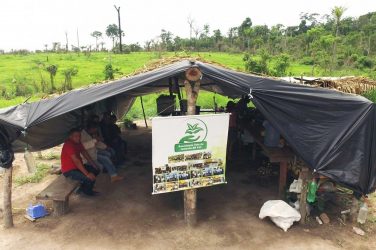


 A group of Indigenous leaders from Brazil began, this Monday, a three-week tour of Europe to raise awareness about the constant discrimination and human rights abuses endured by the Guarani and Kaiowá tribes who populate Brazil’s agricultural heartland.
The delegation of Guarani and Kaiowá people from the southwestern Brazilian state of Mato Grosso do Sul will hold political meetings and other events in Geneva, Berlin, Gothenburg, Brussels, and Vienna till September 30, with further details to be announced about the rest of the trip.
The leaders hope to shine a light on the human rights issues plaguing their communities, including food insecurity and impoverishment that results from the annexation of historically tribal lands by national and multinational corporations.
“Characterized by increasing violence and criminalization of their leaders and supporters, the Guarani and Kaiowá face severe discrimination and an alarming lack of access to justice, which only contribute to the delay of land homologation procedures,” FIAN International, one of the human rights organizations behind the tour, said in a statement.
A recent study conducted by the Brazilian chapter of FIAN and the Indigenous Missionary Council found that three Guarani and Kaiowá communities in Mato Grosso do Sul suffer 100 percent food insecurity, which means that all families reported some level of inadequate food quantity and quality together with a feeling that their access to food would be threatened in the immediate future.
The Guarani and Kaiowá groups of Mato Grosso do Sul have a population of roughly 45,000 people. The communities face longstanding conflicts with agribusiness corporations, as the state is central to Brazil’s soybean industry, which is notorious for displacing small farmers and Indigenous peoples.
And the current political climate in Brazil may only continue to worsen an already bad situation. The administration of President Michel Temer, installed through the impeachment of Dilma Rousseff August 31 plans to list restrictions on foreign land ownership in the country.
Social movements and human rights defenders warn that the drastic policy change will pave the way for a wave of coercive land grabs that will further impoverish Indigenous, rural, and land-poor communities.
The delegation also coincides with the meeting of the U.N. Human Rights Council in New York, where the special rapporteur on the rights of Indigenous people, Victoria Tauli-corpuz, is scheduled to present a report on Brazil after a visit in March at the request of local Indigenous groups.
The European tour will focus on Indigenous rights to food and land, which are also related to systematic racism against their communities and problems of illegal exploitation of their resources and violation of the internationally-recognized right to free, prior and informed consent for all projects on Indigenous land.
teleSUR